Bet on the hand you think ends closer to 9: Player, Banker — or a Tie. You don’t play the cards, they follow fixed rules.
Eight decks. Ace = 1, 2–9 count their value, 10, J, Q, K = 0. Only the last digit of the sum counts (7 + 6 = 3).
Two cards each. An 8 or 9 is a “natural” and ends the round at once.
Player draws a third card on 0–5 and stands on 6–7.
If Player stood, Banker draws on 0–5. Otherwise Banker looks at Player’s third card: 0–2 always draws; 3 draws unless it is an 8; 4 draws on 2–7; 5 draws on 4–7; 6 draws on 6–7; 7 stands.
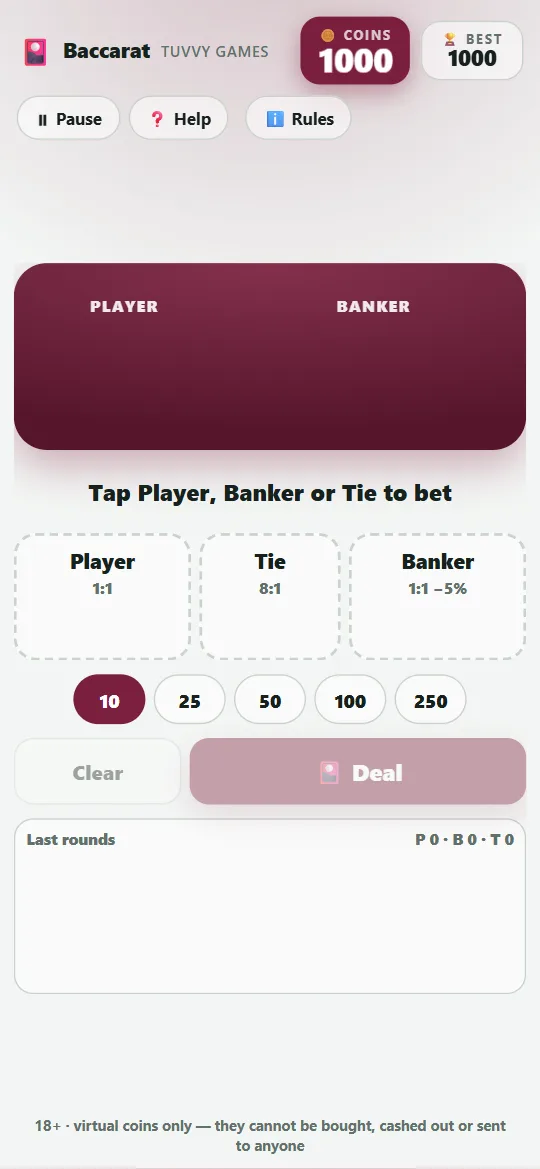
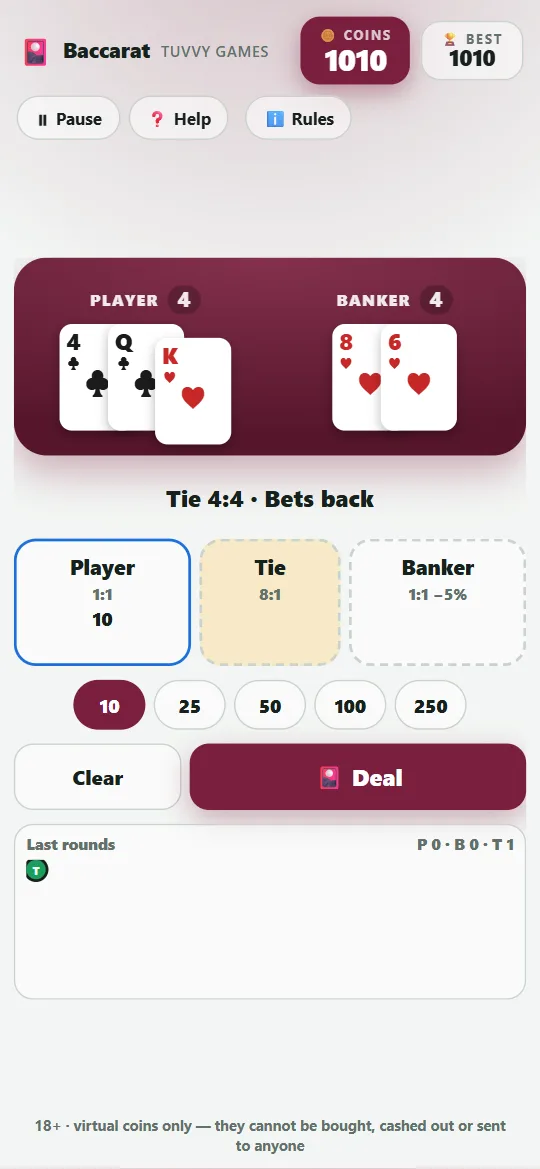
Player pays 1:1, Tie 8:1, Banker 1:1 minus 5% commission. The commission goes into a box under the Banker spot; once it reaches a whole coin, that coin is taken from your wallet. On a tie, Player and Banker bets come back.
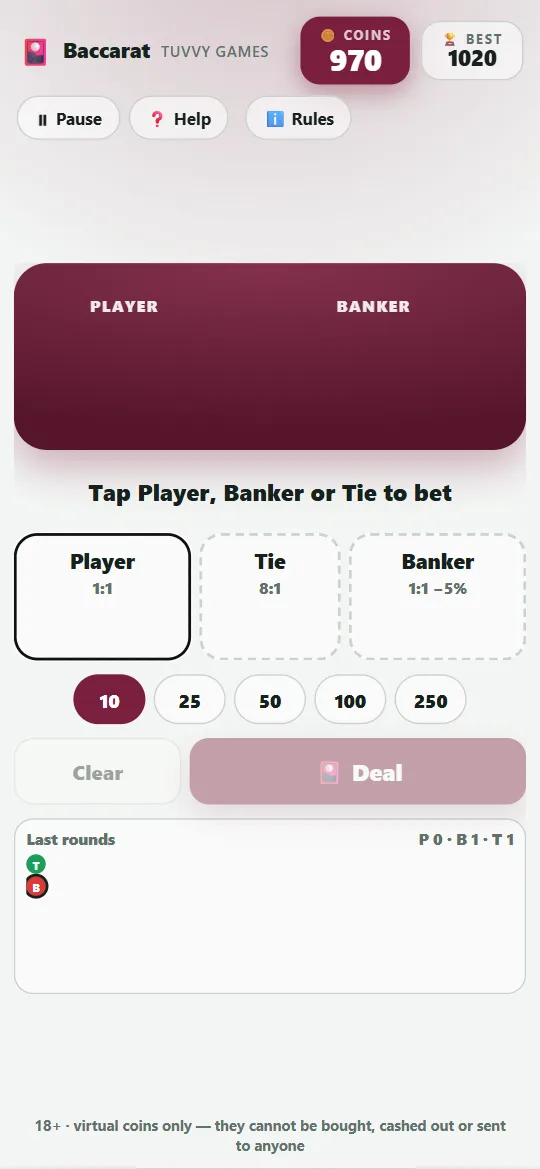
The bead road shows the last rounds: blue P = Player, red B = Banker, green T = Tie, read top to bottom, left to right.
💡 Tips
Banker wins slightly more often, so even after commission it is the best bet (house edge about 1.06%, Player 1.24%).
Tie pays 8:1 but comes up only about 1 round in 10 — its house edge is over 14%.
The bead road is just history: every round is independent, streaks don’t predict the next one.
Tap a spot to put the chosen chip on it, tap it again to take the chip back. Several spots at once are fine; bets stay for the next deal until you tap Clear.
Set a limit before you play and quit while you’re ahead; coins are virtual play money.
 Tuvvy