Four players in two pairs: you (South) and your partner North against the West–East bots. 52 cards, 13 each.
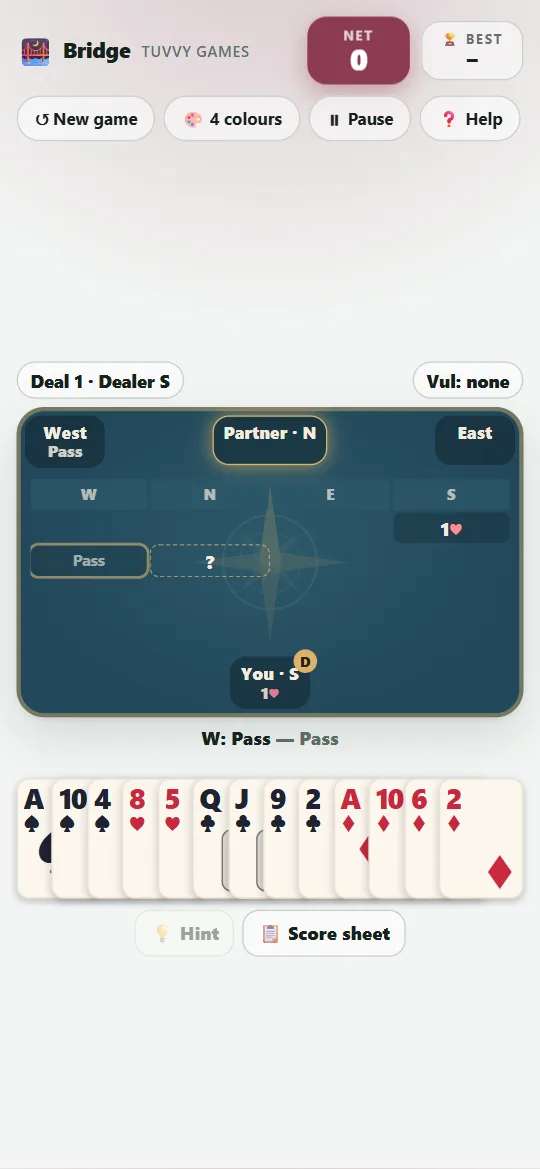
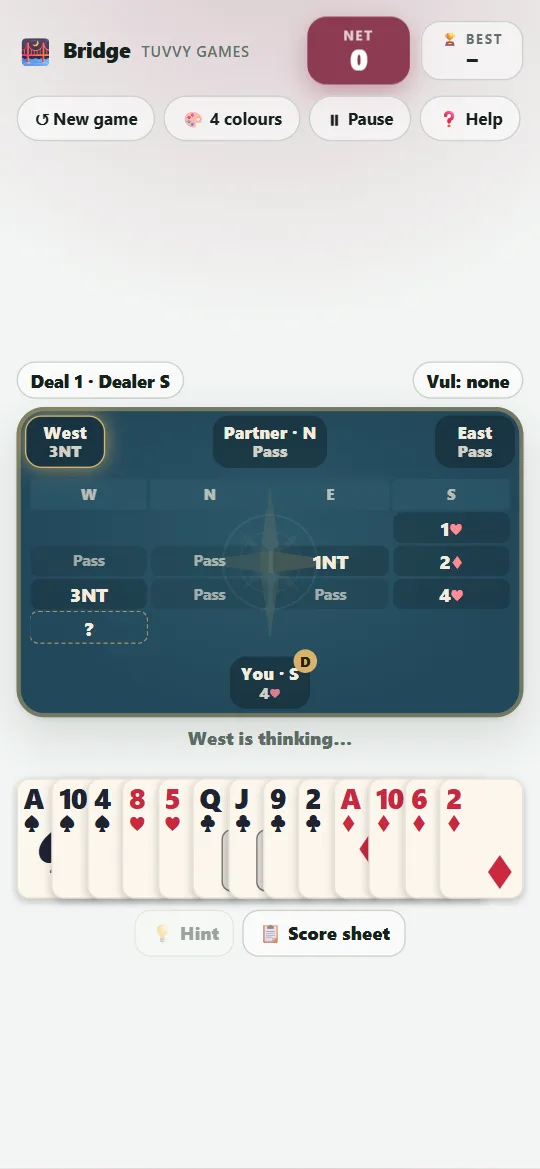
Bidding: each bid names how many tricks over six your pair will take and the trump suit or no trumps (1♣ … 7NT); every bid must be higher than the last one. You can also pass, double the opponents’ bid or redouble. Three passes in a row end the auction.
The last bid is the contract: that pair must take 6 + its level of the 13 tricks. Declarer is the player of that pair who first named the strain. When your pair wins the contract you play both hands — yours and North’s.
Play: the player to declarer’s left leads, then declarer’s partner (the dummy) lays the cards face up. Follow suit if you can; if not, play any card. The highest card of the suit led wins the trick, unless a trump was played.
Scoring: each trick bid is worth 20 in ♣♦, 30 in ♥♠, 40 for the first and 30 for the rest in NT; 100 below the line is a game. Rubber: first pair to win two games, bonus 700 or 500, honours count. Chicago: four deals with fixed vulnerability, game bonus 300 / 500, part-score 50. Slams, overtricks and doubles score extra; every trick you go down scores for the other pair, more when vulnerable (red seats).
💡 Tips
The bots use a simple natural system: 1NT = 15–17 balanced, five-card majors, 2♣ = strong 22+, weak twos, Stayman and transfers after 1NT.
Tap any call in the bidding to see what it shows. 💡 Hint suggests a call or a card the way the bots think.
About 25 points between you and your partner is enough for a game (3NT, 4♥, 4♠), 33 for a small slam. Look for eight cards together in a major.
As declarer, count your sure tricks first, draw trumps while the opponents still hold some, and ruff losers in the hand with fewer trumps.
 Tuvvy